Thursday, February 7, 2008

Foodwriting as a career in India for Me Magazine

Whenever I introduce myself as a food writer I am usually asked “What’s a food writer?”

I recall the first time the question came my way, I simply blurted out the obvious, “A food writer is someone who writes about food” and went on to elaborate on the kinds of articles I wrote and the magazines I had been published in. But the episode comes back to me. After all, how would you answer that question right now?

Good question!

Even Wikipedia does not seem to have an answer.

BUT according to Wikiedia “Food is any substance consumed by living organisms, including liquid drinks. Food is the main source of energy and of nutrition for animals, and is usually of animal or plant origin.” And Writing is defined as “a process which may refer to two activities: the inscribing characters on a medium, with the intention of forming words and other lingual constructs that represent language and record information, or the creation of information to be conveyed through written language.”

So FOOD WRITING could be defined as “the inscribing characters on a medium, with the intention of forming words and other lingual constructs that represent language and record information, or the creation of information on the subject of any substance consumed by living organisms, including liquid drinks to be conveyed through written language.”

Umm… I think I will stick with FOOD WRITING is writing on food. I can hear you going “DUH” at me but try having to explain what you do at least once a day (at the very least) to a PR rep for a restaurant, a publication or just about anyone else and you will sympathize…

This is because food writing is still to a large extent an undefined sector in the publishing industry in India.

On the global scale Food writing has come into its own. Categorized under the larger umbrella of writing in general it has it’s niche and covers everything from articles for print and web to books related to food. It encompasses subjects ranging from food (and drink) production to consumption. That said there are branches within food writing - some food writers choose to stick to certain areas like restaurant criticism – in which case they would be restaurant critics, or wine in which case they would be wine writers or wine critics.

Conversely food writing is an undefined, unrecognized sector in the publishing industry in India. There are less than a handful of food writers about, no formal training courses and even today few publications recognize food writers as specialist writers. In fact Food writing in the true sense of the word is unexplored and books on food are at a very rudimentary stage of evolution. Food writing has a long way to go toward achieving the cult status it enjoys in the West. There are very few food writers in the true sense and no formal training courses. So each step of my journey has been one of learning as I went along.

So does one need to have a specific background or training in order to be a successful food writer?

It will come as a surprise but most food writers and food critics ended up in this field after working in other areas of writing or in another career altogether… Jeffrey Steingarten, the food writer for Vogue, was a lawyer in his past career, Ruth Reichl, Editor in Chief of Gourmet magazine, worked in and later owned a restaurant and closer to home restaurant critic Rashmi Uday Singh author of the Times good food guides was Deputy Director General, Shipping with the, Indian Administrative Service, before she gave it all up to be a food writer.

I take comfort from all these stories because food writing happened entirely by chance for me. I discovered food writing while on a sabbatical from my job. As the mother of a toddler I was pretty much confined to my home and the internet was my lifeline to the world. I spent hours surfing the net and reading about all sorts of things and experimenting with blogging. It was at this time when I was looking for information (on pickles I think) that I discovered egullet.org home to like minded people who reveled in food. I spent weeks dithering around, lurking through its forums, scribbling a line or two here and there until I finally worked up the courage to put up an essay on Uttarakhandi Cuisine. The cuisine in question being unknown, my post got a lot of attention and my inherent talent for research and writing must have come through because I got a lot of praise. The post was the first step to a book that is awaiting publishing but more immediately it brought me a job offer with a local gastronomy magazine and made me realize that perhaps there was a career for me in food writing.

The first realization a food writer must have is that food writing is not just recipe features or restaurant reviews. It goes beyond that. Food writing like all other writing aims to stimulate the senses of the reader either evoking experiences, past or present or more practically motivating the reader out of the armchair and into the kitchen or nearest restaurant.

Not willing to give up being a hands-on mother, I chose to freelance. My first article (not surprisingly) on Utterakhandi cuisine was published in April 2005 in Savvy Cookbook. By June that year I had 3 articles published including an essay on Kutchi food, a recipe feature and a restaurant review, each in a different publication. In retrospect free lancing was the best decision I could have taken because it allowed me to work on a variety of subjects and styles and amass a body of work that I would not have been able to if I had been with just one publication.

Three years down the line today I have more than 400 articles and share viable relationships with at least 12 publications.

When you are starting out it is a good idea to try everything but be wise and use that phase to identify your strengths as well. For instance I prefer to circumvent restaurant reviews and other generic articles. These are easy to write but my approach to them is of a “have to get this article out” sort of attitude as opposed to my usual feeling of eagerness that subjects I gravitate towards inspire. I have found that articles that motivate me are ones that deal with subjects closest to my heart; the food on the plates of real Indians, culinary history, the migration and evolution of cuisine, sustainable agriculture, the intersection of food and culture, food as a carrier in the evolution of a culture (preferably researched at the knees of someone’s mom or grand mom) and my India is a rich country for that.

That said however do focus on your niche once you have identified it. Food writing is relatively unknown in India - I am still slotted under freelance writers at most publications. As a result I am often asked if I could do a story on this or that “just this once”. I did a couple of these in my initial days but stopped when I realised I spent twice the amount of time researching unknown subjects. If you have decided to be a food writer, FOCUS on food writing. Sticking to your niche might lead to lean pickings at the outset but it will pay off in the long run. Once your by-line comes to be associated to one kind of topic and your prowess with the subject comes to the fore more “meaty” assignments will come your way.

I made Rs.1000 for my first assignment. I then spent the ensuing year accepting whatever came my way, regardless of remuneration. One year down the line however, I began to let go of low paying assignments because I found that these were the hardest ones to do. I also began to develop relationships with quality publications. You might need quantity in terms of bylines at the outset of your career but once you are established it is the publication you associate your name with those that count and believe me, the good ones rarely have qualms about paying fairly!

Most of us shy away from appearing avaricious. We are uncomfortable asking for more money. At times like this try to remind yourself that you are having that dialogue about money because the person at the other end feels you are worth pursuing. (let me share a secret here, I don’t stress about appearing greedy ever since I realized that it helps separate the wheat from the chaff!) Once you have work coming in, losing a quickie job that pays too little isn’t a bad thing, it just frees up time for you to write the kind of stuff you want to – paid or not!

Food writing has ups and downs, the best thing is being forced to try new things. Last week, working on an article, I had a great time discovering the amazing variety of green leafy vegetables we use in Indian cuisine (I found 7 in Mumbai alone). I made three new dishes with them; an Irani mixed greens offering called Gormeh subzi, a forgotten Gujarati recipe called Dakho and a concoction all my own combining greens and dals. It was heavenly, but I would never know without trying it all. Food writing is a field that requires constant educating and re-educating. I study nearly every day to keep up with trends and food facts. I inhale every bit of food writing I can get my hands on, have about 500 books on food, encyclopedias and histories of foods and food names. The worst time I have had as a food writer is recently while I was pregnant! With a more adventurous palate I had more exotic cravings as well!

It takes hard work, dedication, perseverance, research, knowledge, an open mind, the ability to multi task and above all passion and creativity to grow as a food-writer but It's an excellent job for someone with a passion for food, writing and learning.

A FEW TIPS

It is important to write properly - When you send in an article, make sure it’s letter perfect. I thought I was a skilled writer until Naresh Fernandes editor of Timeout pulled me up for not spell-checking! He also recommended investing in a copy of Strunk and White which has held me in good stead when i am unsure of something.

Don’t wait for deadline - You can be an excellent writer but not meeting deadlines makes you unreliable. Also your editors are juggling lots of things so if you can send your work in early , do so, I have always found appreciation coming my way when I filed a story before time.

Ensure your information is complete - Do not leave anything to be desired. At the same time strike a balance with information, over loading your reader and making your editor work overtime will not get you more work!

Know your subject - I once accepted an asignment on Japanese cuisine, a cuisine I had never sampled. The publiation never used it. It had no passion. Write on subjects you know, i have found I can write well even on yams if I have experiencesd them. Besides if you are called to discuss your story idea you must be able to. Nobody is going to trust you with an assignment unless they are confident in your abilities.

Understanding your reader - If you’re writing recipe features for a woman’s magazine that is targeted at homemakers – an audience that juggles a budget ands cooks upto 3 meals a day - an article on innovative ways with Daal or quick microwave recipes rather than something like Truffles will be the order of the day, Truffles are better suited to the glossy, lifestyle magazine where your subjects must be in step with culinary trends around the world. You have to be in tune with your reader. That’ll help you identify appropriate ideas for your audience.

Be patient - Okay, you’ve spent hours, sometimes even days, developing story ideas, and if you are like me chances are you’re going to want a response RIGHT NOW. BUT hold on, remember that editor receives tons of similar mail. Every editor I’ve ever worked with has responded in due course. If you don’t hear back in 2-3 weeks then by all means e-mail or phone but keep it short. (Until I got confident enough to wing it on my own, I actually wrote out exactly what I would say over the phone). No extra chitchat, to the point. Remember you’re not trying to make a new friend; you’re trying to get work.

Develop a distinctive voice. This is perhaps the hardest to achieve. Voice is the unmistakable sound, rhythm, and point-of-view that connects with the writer so you know whose written it when you read it. Read writing by M.F.K. Fischer, Nigel Slater and closer home Chitrita Banergee, Vir Sanghvi, Vikram Doctor are people with a voice. When you’re reading them you can hear the authors' voices in your head. And more importantly, you can never confuse or interchange them. Unfortunately, most of us aren’t inherently interesting enough or big enough personalities to pull it off, as these masters do, most of us have to work at finding and developing our voice. But when you succeed, editors will use you again and again. Readers who have read me from my earliest articles might agree that I finally seem to have found my voice. I was inspired by the Laurie Colvin whose books I discovered recently.

Create your own website or blog. The fact is your own space on the web works. And with push button publishing you can do it with a blog, they are free. I include a link to my blog when I introduce myself to a new editor. Even if the assignment does not come my way, they do register me and my knowledge. Until you collect enough published work, the site will also make a good platform for your capabilities.

BOX ON FOOD WRITING CLASS

And then you can also thing of taking classes to augment your talents. Last year I took an online food writing class with Pamela White, publisher of the only periodical that focuses on food writing. In six online lessons, students learn to pitch columns, write articles, query magazines successfully, review restaurants, and write food essays and memoirs. Bonus chapters include tips on styling and photographing food, essential information on copyrights, selling rights and trademarks, and insider advice editors want writers to know. Each lesson includes assignments that guide the writer to successfully understand the lesson. Pam has now turned her original food writing class into a self-study course. "Make Money as a Food Writer in Six Lessons" Information on her course and book is available at http://www.food-writing.com/


Wednesday, October 24, 2007

Looking forward to American Masala


I see that Suvir's new book is out and I am looking forward to getting my hands on a copy.

His first book Indian Home Cooking: A Fresh Introduction to Indian Food holds its own on my bookshelf, but to be honest I bought it more out of curiosity than to actually cook from it. I had interacted with Suvir on various food forums and also tried his recipe for Tomato Chutney with excellent resuts so I wanted to see what the book was like. The book did not have too much in terms of new unusual recipes, some of the more unusual ones like the Shrimp Rasam and Lamb Biryani with Orange and Whole Garam Masala are now regulars on my recipe list. Indian Home Cooking has also become my favourite book to give novices to Indian cuisine as gifts. It very succintly lays down the basics of Indian food philosophy and the recipes are laid out for a western reader using recies that could be found in most western supermarkets.

But his latest offering, American Masalla promises to be a culinary adventure. I have observed how innovative Indian cooks are with local ingredients from my wanderings on Another Subcontinent and Egullet so I am sure that this book will offer some interesting ideas. I can't help looking forward to it much much more, unfortunately with the baby 10 days away, I will likely have to wait a while before i can get a copy! But with the hiatus I will be on then, I will have more time to try out recipes so untill then I shall console myself by trying this recipe for Chicken Harira from the book that Suvir has on his blog.

At the moment it is not available in India but can be ordered from Amazon.

Rushina

Monday, September 24, 2007

Book on the cuisine of the Planpuri Jain Community Dadimano varso - (Grandmother's legacy)


Everybody knows Gujarati Cuisine is distinctively vegetarian. With about 65% of the state's population shunning meat it has to be, but it's culinary versatality is legendary. A versatality underlined in the number of regional cuisines found within the state itself. One such regionally distinct cuisine is that of the Palanpuri Jains.

Jainism teaches that every human is responsible for his/her actions. It believes that all living beings have an eternal soul or jīva and insists that Jains live, think and act respectfully, honoring the spirit of all life. Jains view God as the unchanging traits of the pure soul of each living being and nonviolence extends to every aspect of their lives including their culinary practices.

Jains go beyond just shunning any kind of meat, their stance on nonviolence proscribes even food obtained with unnecessary cruelty. Observant Jains do not eat, drink, or travel after sunset (which is called Chauvihar) and always rise before sunrise. They do not eat root vegetables like potatoes, carrot, radish, ginger, sweet potato, white yam, because to obtain them is an unnecessary of the life of the entire plant. Garlic and onions are shunned as they are bulbs that germinate into plants.

Other foods like Brinjal, cheese, cream, honey, raw milk and yoghurt, stale food (because eating such food involves the killing of various kinds of microscopic creatures and germs) are veiwed as generative of life and so eating them amounts to violence, fruit salad, ice‑cream, fruit‑yoghurt combinations and all antibiotic medicines are prohibited. Infact even green and raw vegetables are prohibited on certain days and many Jains choose to be vegan due to the violence of modern dairy farms.

While the jain community all subscribe to similar food proscriptions there are regional differences amongst them as well. With the area of Palanpur being closer to Rajasthan, the proximity manifests itself in their cooking with increased use of ghee.

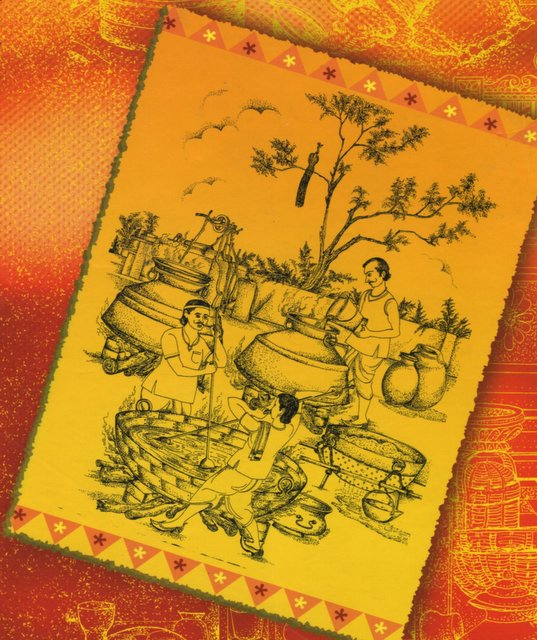
Illustration from front cover

Dadima no Varso which translates to "Grandmother's legacy", is a veritable tome of a book published by the Palanpuri Samaj Kendra. It was the brainchild of Nita S. Mehta, Rajul A Gandhi and Dr. Satyavati S. Jhaveri but it is the hard work of the 35 ladies that make up the Rachna group of women. When it came to chosing a name for the book, Dadima no varso seemed a logical choice, because the recipes were all collected from grandmothers.

What began as a cookbook to document speciality recipes soon grew into a guide to younger generations, encompassing every aspect of the communities culinary traditions as research revealed recipes and aspects of the cuisine unknown to the authors. "This is our contribution to society" says one of the ladies, "others contribute money, we have contributed our time.

And time consuming it was, with all the recipes being collected in the words of the grandmothers and measured in handfuls and pinches and then tested for exact measurements by the ladies of the group. Then with the book printed simultaneously in two languages - Gujarati and English versions of each recipe alongside each other - it also required close scrutiny by people with a grasp of both languages and culinary skills as well.

That this is a labour of love shines through with every page you turn. There are recipes for everything from celebratory dishes for festivals to fasting dishes for the Jain paryushan period and even mouth fresheners for the end of meals.

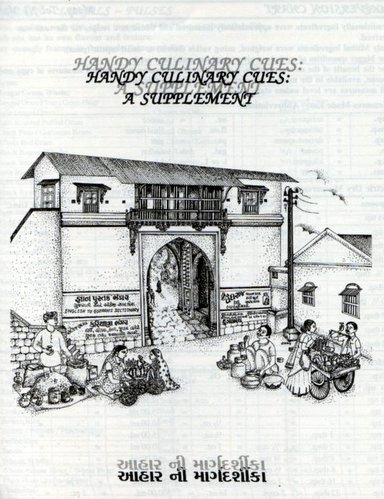
Illustration from back cover

There are color representations of every dish in the photographs in each section but in addition to this beautiful illustrations and line drawings by Ramchandrabhai Chauhan, an award winning artist augment the pages of this book, offering an insight into the traditioanal foodways and life of the Palampuri Jains.

Illustration from section header

Copies of the book are available from the Palampur Samaj Kendra,
151 Shanti, August Kranti Marg, Mumbai 36.
Phone 23632288
Posted by Picasa

Monday, July 2, 2007

Review - Grains, Greens, and Grated Coconuts - Recipes and Remembrances of a Vegetarian Legacy

Book review for 4th Dimension Woman.

Fragrant with the aromas of pepper and curry leaves and delicious for it, Grains, Greens, and Grated Coconuts - Recipes and Remembrances of a Vegetarian Legacy, by Ammini Ramachandran is more than a cookbook. Through it Ramachandran a food writer of Kerela origin based in America, has shattered several stereotypes; that community cookbooks are self published black on white with recipe after recipe and no space wasted on frivolous things like anecdotes. That South Indian food ends at idli, dosa, vada, sambhar. And most importantly that Kerela cuisine is seafood based and non vegetarian.

Without being heavy handed with spices or making the cuisine exotic beyond recognition the author takes us on an exploration of the traditional Hindu vegetarian cuisine of the royal family and the Nayar community of Kochi in central Kerala. Each recipe is laid out against a backdrop of its position on the banana leaf, in the seasonal diet and in traditional rituals as well. Unlike some memoirs in which recipes seem to be an afterthought, each recipe in this book is easy to do, systematically laid out and broad - mindedly allowing for shortcuts that work today. Timely instructions allow even newbies to anticipate the next step and the added sharing of occasional anecdotes and friendly advice almost gives the illusion that Ramachandran is standing by you, guiding you through the recipe and sharing her first experiences with it. For cookbook aficionados like me - who enjoy stories with their food - there is ample fodder for the mind as well. A brief but erudite chapter on the history of the spice trade in Kerala, the cultural background, culinary customs, festivals and traditions of the traditional Kerela kitchen and home, all coloured by the authors own growing years in one of the few surviving matrilineal societies of the world. “Grains, Greens, and Grated Coconuts” captures the pride of a woman in her heritage, gently reminding us that progress may be all around us but it is possible to hold on to tradition.

Try a recipe from the book, Scroll down this post for a recipe from the book.

For more on the book and the author visit www.peppertrail.com

The book is available from Ingram Book Group, Baker & Taylor, iUniverse, Inc., Amazon.com, BarnesandNoble.com and booksamillion.com.

Publisher: iUniverse, Inc. (March 4, 2007)


Mindless Eating - Why we eat more than we think.

Mindless Eating - Why we eat more than we think.

Browsing through Crosswords bookstore at Kemps Corner one day I mindlessly picked up, well, “Mindless Eating”. It was the question “Wondering why you ate too much popcorn or Chinese food?” in one of the comments on the back cover that caught my eye. Since the one thing I cannot resist is Chinese food - I probably eat Chinese once a week and the totally “paisa vasool” but absolutely unhealthy personal buffet at the Mah Jong restaurant in Khar has been on the menu a lot off late - I wanted to see what would convince me to eat less of it!

Closer examination revealed that the author Brian Wansink Ph.D is a food psychologist who specializes in investigating the mental and emotional factors that cause us to eat. A food anything will usually catch my attention but a food psychologist was a new one and I bought the book despite the steep price.

According to the Mindless eating , each time I give in to this craving for Chinese food, I consume unnecessary calories. Just to check I got some expert input. According to nutritionist Naini Setalvad, “an ideal restaurant meal should total upto 500 – 800 calories, but in the case of Indian Chinese, which comprises of deep fried, corn flour gravy smothered dishes like Manchrian, Chilli chicken, and fried wontons, your calorie intake can shoot up to a whopping 2-3000 calories at a single meal. Factor in the buffet format, and you can cross all limits!” Taking into account the tendency most of us have to eat until our stomachs protest, this is worrying.

The problem lies in tendency most of us have to eat until our stomachs protest since, as mindless eating points out, our stomachs can’t count how much we eat and therefore don’t know when to stop. It goes on to say that an average person of normal weight underestimates their food intake by 20% and an obese person by 30 – 40%. Citing various case studies Mindless Eating illustrates the solution – while the stomach cannot count, the eyes can.

According to Mindless eating, if one was presented with the entire volume of food they consumed after several servings at a buffet, one would not be able to eat it all. It suggests you see your food before and while you eat it. Have you ever noticed how leaving restaurants that serve plated food, you are usually pleasantly full as opposed to bursting? Come to think of it, I rarely manage to actually clear the plate on these occasions! Plating meals result in you consuming 14% less then when you have everything handy for refills.

That said however plating food is tough to do in the Indian meal format but here is a workable solution. Serve recommended amounts of Dal, rice and rotis into your plate and leave serving bowls of them in the kitchen, out of sight. However keep vegetables and salads in front of you at the table. This results in the healthier options being more accessible making it more likely for you to reach for them to fill the gap between the stages of “I could eat some more” and “I am full”.

This is only one of the lessons I learnt from Mindless Eating, the book has many more. The essential lesson the book teaches however, is that the mindless food choices we make can add 200 - 300 calories to our diet daily amounting to 12-15 kgs annually! However, just like ones mind is conditioned to make the choices that result in weight gain, it can be reconditioned to lose weight, simply by being more mindful of one’s eating habits.

The message is a valuable one. It is also eruditely delivered in snappy packaging. The chapters are full of interesting, case studies based on scientific research but presented in an eminently readable avatar and each chapter concludes with solutions to the issues it studies.

What I appreciated most about Mindless Eating however was that it focused on the micro-environment – my surroundings as opposed to a macro-food environment of the world that other books have covered. After all it is my immediate environment that directly influences my food choices on a daily basis; tells me how seemingly unimportant choices such as the size of the plate I eat from, my dining company, and even the ambiance I eat in influences how much food I will serve and eat. It also underlined to me that as the primary food provider I am the Nutritional Gatekeeper in my home and 72% of what my family eats inside and outside the home is because of choices I make.

To think I almost put it back because I thought it was a diet book! I hadn’t read the first and last sentence of the book then - “The best diet is the one you don’t know you’re on!”

Here is a link to the authors blog and website.


Sunday, July 1, 2007

Indian cuisine – so vast is this subject that it is easy to get lost in the maze of sometimes half baked and occasionally totally wrong information available. Here is a guide to some books on various aspects of Indian food.

No matter where in the world we live, the food we eat today is a result of our ancestors experimenting with all sorts of strange ingredients and cooking methods prior to settling on the best form of the ingredient to use and the best method to use it in. Indian Cuisine has classified, categorised and attributed every ingredient available to it with specific properties and functions and every cooking method and culinary traditions a long time ago. It would then be logical that anyone wanting to learn about Indian Cuisine would want to be introduced to its history first. There are only a few sources in English for this aspect of Indian Cuisine. An older out of print book called the Cooking of India by the Time-Life Foods of the World series written by Santha Rama Rau is a classic and still fairly impressive. One can still find stray copies on the Internet.

The most comprehensive and only easily available book on Indian food is the Historical Dictionary of Indian Food by K.T.Achaya, a concise version of his earlier book Indian Food: A Historical Companion. A content rich book that I find myself returning to repeatedly when looking for information on the origins of ingredients, food ways and historical trivia on Indian food; like the fact that it correctly attributes maize, coffee beans, tomatoes and potatoes as having come from the new world, which have caused extensive debates amongst friends who refuse to accept these things as fact, especially the great shocker = that chilies only came to India with the Portuguese!

Happy news is the latest entrant to this genre of books, Curry: A Tale of Cooks and Conquerors is a densely written history of Indian cuisine exploring selec byways of Indian cuisine, occaissionally losing focus (but happily so) of the fact that the evolution of Indian cuisine was feuled by a series of invaders—the Mughals of Central Asia, followed by the Portuguese and eventually the British—who fused their own culinary traditions with those of the Subcontinent, producing entirely new dishes such as, Curry! Collingham traces creation and eventual disintegration of curry from a spicy pan-Indian dish with many regional variations into a noxious all-purpose turmeric-heavy powder manufactured in England to pacify civil servants longing who pined for the lost pleasures of the Anglo-Indian table they left behind in India.

Before one would have even finished reading the historical background of Indian cuisine one would be inspired to cook it and The Indian Kitchen by Monisha Bharadwaj is the perfect book for this stage of one’s growing curiosity about Indian food. One of my dearest possessions this timeless book discusses Indian ingredients, grouping them into categories; spices, pulses, herbs, grains, vegetables, fruit and then covering each individual item in 1 -2 page spreads illustrated with photos and information on origins, sources, preservation, culinary and medicinal uses and a couple of easy recipes for each. I consider this book the perfect gift because it is helpful for the novice as well as the knowledgeable so that one might identify everything from the commonplace to the elusive.

Less encyclopedia like and full of personal anecdotes the next book really is an “Invitation to Indian Cooking”. This classic by Madhur Jaffrey is full of recipes from the north Indian-Delhi culinary style and when your palate is curious enough to get more adventurous try Jaffrey's “A Taste of India", it only covers the most obvious regions and select recipes from even those but what it covers is packaged and delivered well and certainly offers the perfect primer the intricacies of regional cuisines of India. As rich with anecdotes is Indian Home Cooking by Suvir Saran the acclaimed chef and cooking teacher and driving force behind the Devi restaurant in New York. This book lays a rich cornucopia of information alongside recipes for fuss free, home-style Indian dishes for everyday cooking written for a western audience, using ingredients found in most supermarkets.

Once your appetite for the intricacies of Indian cuisine are truly whetted and you are looking to get deeper in the regional cuisines of India there is a large selection of books available from Penguin. Their regional series are erudite books that cover the history and culture of each community before getting down to educating the reader on the cuisine of the community and although the recipes can sometimes be off the mark, they certainly are delicious reads. Starting in the north with The Kashmiri cookbook by Sudhir Dhar, the collection winds through Delhi with the very informative Flavours of Delhi by Charmaine O'Brien and makes it’s way East to the “seven sister” states of Sikkim, Arunalchal Pradesh, Assam, Meghalaya, Nagaland, Manipur, Mizoram, and throwing light on the relatively unknown cuisine of this part of India with the Essential North-East Cookbook by Hoihnu Hauzel. The Calcutta Cookbook, Meenakshie Das Gupta, Bunny Gupta, Jaya Chaliha is an overview of the history of cuisine in Calcutta including chapters on the different influences on the cuisine as well. (Das Gupta is the author of Bangla Ranna which is the legendary classic that preceded this one. Heading south The Essential Andhra Cookbook, educates on the fiery cuisine of the Andhra region as well as the royal cuisine of the Mughals. The Essential Goa Cookbook, throws light on the rich heritage of Goan cuisine with its Dutch and Portugese influences. The Essential Kodava Cookbook by C B Muthamma and P Gangamma Bopanna is another jewel of a book not so much in the narrative but rather in the fact that it illuminates another hidden but rich cuisine of India that of the Coorg community, a race said to have descended from the Greek Warriors of Alexander’s army.

Besides the many regional variations, there have been many influences on Indian cuisine, the culinary influences of the British are covered in Taste of the Raj by Pat Chapman founder of the Curry Club in the UK. Content rich and a real account of culinary and family history is Curries & Bugles by Jennifer Brennan while The Raj at Table by David Burton is a more professional take on Raj history and food. Parsis are a community originating from Persia who settled on the West coast of India and evolved both a culture and a cuisine that was a blend of their heritage and their new homeland. Parsi food and Customs by Bhicoo J. Manekshaw which is part of the part of the Penguin Indian cuisine series, covers, the history, traditions, customs and cuisine of the Parsis. Also part of the same series is Anglo-Indian Food and Customs by Patricia Brown which very efficiently covers the history, traditions, customs and cuisine of the Anglo Indian Community of India.

The above list just skims the surface of books on various aspects of Indian cuisine. Underneath lies a wast sea of Information that has yet to be fully explored. The next layer of books I intend to delve into are community cookbooks. Cookbooks self published by enterprising ladies or representative bodies of the various communities of India. Communities that are defined by religion, geograhical location, history and a variety of other things but one commonality - they each have a cuisine of their own.

When these books have been explored, there is a deeper layer to delve into. Beyond the books that have been printed in english, there is a sea of self published local language cookbooks that exist all over India. Books that have never been explored because of the language barrier that exists due to so many regional languages that exist all over the country. I never thought about this untill my Pune based friend Uma Iyer brought my attention to the amazing wealth of information she has discovered in local Maharashtrian books. She discovered these 20-30 rupee books available in local bookstores and has been exploring them for the last few weeks with great results.

Rushina

Friday, September 29, 2006

Interview with Usha Prabhakaran author of Usha's Pickle digest

Interview with Usha Prabhakaran author of Usha's Pickle digest

Usha Prabhakaran is the self published author of "Ushas Pickle digest", "The perfect Pickle book" as it says on the cover. A thick volume of 365 pages, the book contains exactly 1000 recipes, is meticulously researched, perfectly cross-referenced and according to my friend Vikram Doctor food columnist with ETworth it for the multilingual ingredient glossary alone. (In fact it was Vikram who showed me the book almost a year an a half ago. He had found it at Landmark bookstores in Chennai.)

Always fascinated with the idea of pickles and its associated traditions - I was intrigued to hear of this extremely well put together book. Unfortunately by the time I went looking for it not a single book store in India had a copy left. I kept looking for the author, Usha Prabhakaran and her book off an on with the help of friends until we finally managed to get a number for her.

Untill the moment I called her I knew her as the author of an excellent book that had been self published (and anyone who has tried to sell a book to an Indian publisher will recognize that as a feat in itself) but after I spoke to her my respect and admiration became awe and inspiration. Not only did I find out that Usha had survived a fatal disease but she the disease had struck the day her book was published.

Here is an interview I have conducted of her via the internet and on the phone.

When did you decide to write a book on pickles and what made you decide to write a book about pickles?

Whoever had the opportunity of eating my pickles liked them very much and I found myself meticulously writing down the recipes for them. That is when the seed for a pickle book was planted in my mind. After all the pickle is a great subject to write about because it is compatible with almost any dish, can be easily adopted to suit available ingredients, countries and palates and following canons of pickling allows for them to be prepared without much difficulty. Also store bought pickles have preservatives added to them which can be avoided if the pickles are prepared at home which is an added advantage and of course home made pickles are always tastier, being made with first quality ingredients.

How did you go about your research, which were some of the people you spoke to?

Whenever and wherever I taste something new, I instantly approach the person that made it without any hesitation whatsoever and tell them how tasty their recipe was and ask if I could jot down the preparation method. My book is a tribute to the many housewives in general and to the Komitti Chettar community in particular, who generously and painstakingly shared their recipes with me, happy in the knowledge that the information they parted with will be documented and be part of a valuable pickle recipe book.

Did you learn anything unusual from any older person you spoke with during your research?

I found all the old persons as a rule very disciplined and fastidious. Pickling required that there should be no moisture of any sort in the containers, the vegetables should be dry, adequate salt should be added, the pickle should be steeped in oil etc. Experienced hands were extremely particular with vegetable, spice and oil selection, they used pickle jars that had been washed and dried in the sun and were particular about using home ground spices (chili, turmeric, asafetida, fenugreek etc. as much as possible doing the grinding themselves in many cases, no matter how tedious, or tiring, because they believed much of the end result depended on these things.

Is there anyone you spoke to in your research of recipes whom you will never forget?

Apart from my mom-in-law, I had a neighbor - a very close friend of my mother's – who taught me all I needed to know about Andhra pickling but I can safely say that I did not spare any person who I felt would add some value to my book.

What made you decide to self-publish?

Publishing a book means finding a publisher worth the name and finding one such is not that easy to come by, if the effort happens to be your first one. So I decided to go it alone – it gives you such a sense of pride and achievement, believe me. I have not for one moment regretted it, although the book would have sold faster with glossy pictures et al. and been a more economic deal with greater visibility, if published by an established publisher.

Did you have problems publishing your book? What hurdles did you face?

As already mentioned, the publishers I went to – the ones who you think you would like to be associated with - placed restrictions: time wise/other publisher-wise/money-wise etc. These were not things I could accept. Deep in my heart I knew, a good thing would speak for itself.

Why do you think pickling has been popular in India?

India is blessed with cheap and plentiful availability of a staggering variety of vegetables, fruits, spices and oils. It is no wonder then that pickling has always been popular in India. India being a hot country, hot spicy foods such as pickles which perk up any meal and whose diversity is well recognized are key features of Indian cuisine. This is especially true of South India. Pickles go well with rice, idli, dosa, chappathi (and all other Indian breads), puri, parathas etc. Naturally every community and every family has a tradition of pickling.

How did you become interested in pickles?

My mother-in-law hails from the Komitti Chettiar family, originally from Andhra Pradesh, with a long and highly regarded tradition of pickle making. After every visit to her place, I would return home with bottles of tasty, mouth-watering delicacies. I wanted to document these pickle recipes so that they would not be lost to posterity.

What have you found are some of the major differences between pickles from different parts of India?

Although mango is the preferred base vegetable for pickling, the fundamental variation is that in the north the pickles are made with chilly powder, turmeric powder, garam masala, vinegar or lime juice, sugar and mustard oil, while in the south, the same pickle is prepared with chilly powder, turmeric powder, asafoetida, tamarind extract or lime juice, jaggery and gingelly oil. In the north, east and west, the preference is for sweet and sour pickles. In the south, the sweet portion is hardly visible. Besides these pickles being made at home, no artificial preservatives are used.

In your research have you found any health risks related to pickled foods?

Pickled foods do not cause health risks. If a person is already suffering from ailments, she/he can be selective in the choice of pickles. In general because of the spices used in them, pickles stimulate the appetite, aid digestion, cool the system, cure cough and cold etc. You will be amazed at the highly spiced Andhra avakkai ( A.P) being consumed in enormous quantity, with little or no side effects. This could be attributed to the large consumption of ghee.

On the positive side, you have propagated that pickles can be effective in treating various ailments, Can you elaborate on that?

The spice and seasoning used in pickling have clearly defined attributes that help the body in specific functions. Spices are anti-oxidants, so they act as free-radical scavengers. Pickles contain essential oils that help to kill bacteria in the intestinal tract.

Ginger, asafoetida and turmeric are all considered digestives. They are pickled with beans or split peas to fight off their hard–to-digest stubbornness. Mint does the same thing. It also kills germs. Asafoetida is considered a nerve tonic; Cumin and green cardamom are cooling, clove and cinnamon are warming, ginger is good for the cold, raw garlic is good for circulatory ailments or jangled nerves, red chilies in small doses have antiseptic properties, black pepper promotes appetite and acts as a tonic for new mothers.

When reading your book you soon realize how many variations of food can get pickled. Was there any food that you were surprised to find in a pickle recipe?

Sure, I will give you an example. I generally look for great variety in food that can be pickled. I was truly amazed when I learnt that hibiscus flower is a good base material for pickle making.

Do you think it is important to preserve traditional recipes and food lore? If yes, why?

Indeed, there can be no doubt that traditional pickle recipes and food lore should be preserved. Pickling is an art and as in the case of all art forms, pickling is time consuming, but if left unrecorded, the recipes and the food lore that go with them will be lost to posterity. Traditional methods can often be laborious and time consuming, but the final product is tasty.

What are some of your favorite recipes out of your book?

Some of the favorite recipes from my book are small red onion in tamarind sauce (27), sweet and sour orange peel (30), plantain flower – hot (32), stuffed kalakkai chain – oil less (70), curd gooseberry – green chilly- watery (490).

What was the first pickle you made?

Mango-ginger was the pickle I experimented with first and most of my friends still love it. It is easy to make, the peeled slices of mango-ginger are combined with chopped garlic, a few strands of green pepper and tossed in salt and lemon juice. The pickle required frequent turning to prevent spoilage and lasts for up to 10 days at room temperature and about a month in the refrigerator.

Which is your favorite pickle to make now?

Gooseberry pickle in whipped curd is a pickle I like to prepare. All you have to do is whip up some curd (yogurt) with turmeric powder, salt and a generous amount of water and whip well again, steam the gooseberries and remove their segments, reserve but discarding the seeds. Heat oil and season with mustard seed, green chilly, curry leaves and stir into the whipped curd mix. Add in the gooseberry segments and mix well. The pickle can be used after a few hours and stores well up to a month in the refrigerator.

What is your favorite pickle to eat, do you like sweet pickles, spicy ones or sour ones?

I love spicy pickles with a dash of sweetness and sourness. I don't much fancy sweet pickles and I love the Methi sprouts pickle because it's health-giving properties. Methi seeds are soaked in the water for about 8 hours then drained and wrapped up in a damp cloth. The cloth is to be constantly moistened, to ensure that the sprouts appear. When the sprouts reach the desired length i.e. 1cm. approximately, the sprouts are pickled with tamarind extract, chilly powder, turmeric powder, asafoetida powder, jaggery and salt boiled in oil. The sprouts are to be sautéed for a very short time, because otherwise the pickle will become bitter.

Which was the most unusual pickle you come across in your research?

On a visit to the home of one of my husband's relatives I was told that I could create a great pickle out of curry leaf seeds. I tried it out and found it out to be out of this world. Not only was it delicious, it is also rich in vitamin A & D, and good for hair growth.

I know you are working on your second book on Rasams. Could you tell me more about Rasams?

Rasams are usually watery sometimes thicker, concoctions made from different vegetables, fruits, grains or combinations of these, with the addition of cooked dals and seasoned with ghee or oil. The seasoning normally contains a few spices like mustard seeds, curry leaves, asafoetida, cumin seeds etc. There are rasams prepared from grains, plain and sprouted, leafy greens, herbs, vegetables and fruits.

When will the book be published?

Usha's Rasam Digest is likely to be published in 2 months' time.

What are some of the interesting recipes you have covered in it?

You would be surprised to find rasam being prepared from waste vegetable materials like peas pods of fresh green peas along with ginger, green chilly and onion, addition of powdered pepper and cumin and seasoned with cumin seeds and crushed garlic seasoned in ghee.

Unripe tomato rasam is a favorite with me. When we utter the word rasam it conjures up images of a ripe tomato in tamarind sauce but this is not the case here. Here the rasam with tender green tomato is pressure-cooked with toor dal, turmeric powder and gingelly oil. Later, the rasam mix is boiled with rasam powder, salt and seasoned with mustard and asafoetida powder fried in ghee.

What advice do you have for people who wish to write a book and self publish?

Writing keeps the mind active and writing or working on a subject one likes does not tire a person too much. Self – publish one must because, although it costs a little more, one can be proud of it at the same time.