Showing posts with label Indian community cookbooks. Show all posts

Wednesday, September 29, 2010

Launch of book The Food Trail of Punjab by Yashbir Sharma (a food travelogue).

The Cookshelf from A Perfect Bite was proud to host the launch of Yashbir Sharma’s new book The Food trails of Punjab on the 27th of September over a fabulous dinner of Punjabi food generously catered by the Legacy of Punjab restaurant. We were also honored to have some of the foodiest of foodies of Mumbai join us for the happy occasion.
 
I started Cookshelf  because, thanks to my friend foodwriter Vikram Doctor I have acquired an addiction to books on food and I wanted to create a repository of information of foodwriting and food books from around the world but most specifically from Indian. It is a work in progress, that I am adding to slowly. An objective of this blog is also to help good food books get attention. Having tried, rather unsuccessfully to sell my book on Uttaranchali cuisine to publishers for the last five years, I know how frustrating it is to have a good book and not find a publisher. And there are many brave foodwriters out there who believe in their books enough to put their money behind their passion and self publish books. One such man is Yashbir Sharma.
Yashbir Sharma
I first heard about Yashbir uncle and his first book The Dhabas of Amritsar through one of Vikram’s columns on restaurant cookbooks in ET, but never actually found a copy to look at. And then as serendipity would have it, I happened to meet his nephew, Manish. After that it was just a matter of me nagging Manish until he introduced me! When I finally met Yashbir Sharma, at his home in Delhi a few months ago  I was disappointed to hear that he did not have any copies of his book left BUT was quickly heartened to hear that he was soon to release a new book! I even got to see the dummy version of the book that he was self publishing; The Food Trail of Punjab. 
The Book - The food trail of Punjab
I decided right there that I would do whatever I could to help spread the word on the book. And when Yashbir Uuncle called last week to say he was bringing me some of the first copies of the book, I was thrilled. I worked against time, (even emailing from my phone of the deck of a houseboat on Kerela’s backwaters) to pull together the launch. Before I go on about the evening and the book, I would like to thank Varun Dhingra of the Legacy of Punjab restaurant, without which this evening could not have been as delicious. To launch a food book you need good food at the event and my big concern was what to serve for dinner. I am a good cook but for a book on Punjab I needed good Punjabi food, an area in which my repertoire is small. But luck favoured me again and as I was discussing things with my friend Pooja of Le 15 Patisserie, she told me that her brother Varun ran a Punjabi restaurant that had Amritsari cooks in the kitchen and would be happy to help with this. And so the table was set for The food Trail of Punjab to take off.
Varun Dhingra of the Legacy of Punjab restaurant
Amritsari Tikkis from Legacy of Punjab
As we dug into Amritsari Tikkis slathered in lashings of chutneys and Mooli salad, Yashbir Uncle told us about this book that was two years and several trips to Punjab in the making. 

"It all started when I was in Amritsar, I had an upset stomach  and decided to have some Trotters soup in Amritsar. Before you know it I was fine. The water of Amritsar is very good for the digestion. It allows one to eat the local food without getting sick." he said and the thought struck him to document the food of Punjab. And so he embarked on a happy trip through the state, pen and camera at the ready. 

“I have travelled the length and breadth of Punjab and found its people amazingly simple in their eating habits. Yet, they don’t compromise on their food. It is nutritious and delicious, with no frills attached to it. The recipes are simple, the Masallas do not number more than 7-8” 

The fertile state of Punjab in North India has always been considered the “bread basket” of the country. Famous for its vast rolling plains, endless fields of wheat, corn, millet and rice and the food! For the hardworking people of Punjab, every meal is little celebration and wherever you eat in this part of India, be it at restaurant, a roadside dhabba (as local street-side food vending stalls are referred to) or in a Punjabi home, quantity is definitely a measure of quality partly because Punjabis like to eat well but also because they love to lay a laden table.

And it is this legacy that the Food trail of Punjab brings us through recipes and the unforgettable stories behind them, culled from the owners of iconic eateries across Punjab. Featured in it’s pages are such hearty iconic delights as Kara Prasad, Dal Makhani, Amritsar Da Mutton, Gajjar da Murraba Meen Punjabi-Chinni Ishtyle Chicken and winding its way between these recipes, in the best tradition of the food travelogue are stories, vignettes of history, stories of iconic establishments and the people that run them. Full of candid photographs, charming commentary impassioned memories of the people and food of Punjab. The Food Trail of Punjab is a delicious romp of a book guaranteed to get you craving for a Punjabi meal.


It is a book that any food lover - but especially those who are afficionados of indian food and Indian culinary history - should aspire to own, because it celebrates an era of food - the kind that loved simple flavours, oodles of ghee and lots of deep frying - that is an iconic part of Indian cuisine and needs to preserved. 

Fabulous stuffed Kulchas!

Tandoori Rotis
Shanky and Lotsoffood!


Shanky
Feast of Food and friends

The French connection? Food writer Mangal Dalal and Pooja Dhingra of Le 15
Chole
Mini Rasmalai
The book and the food!  

---------------------------------------------------------------------------------
GYAN
The Food Trail of Punjab is widely available at bookstores all over India. For more information you can get in touch with Mr. Sharma at mryashbirsharma(at)gmail(dot)com. 

‘Legacy of Punjab’ Asli Punjab Da Tashan as a grade 1 restaurant on the Mumbai – Nashik / Shirdi highway, 3km from Shangrila Waterpark. A spacious restaurant, that recreates the ambiance of a Punjabi farm house, Legacy of Punjab, uses solar energy fas its primary power source and growis most of ithe produce it uses on the 10,000 sq feet farm attached to the restaurant where vegetables like cauliflower, okra, brinjals, sugar cane, corn, papayas, radish flourish. For further enquiries please call +91 93231 07555 begin_of_the_skype_highlighting              +91 93231 07555      end_of_the_skype_highlighting or email legacyofpunjab@gmail.com, or look for them Facebook under Legacy of Punjab.

Monday, September 24, 2007

Book on the cuisine of the Planpuri Jain Community Dadimano varso - (Grandmother's legacy)


Everybody knows Gujarati Cuisine is distinctively vegetarian. With about 65% of the state's population shunning meat it has to be, but it's culinary versatality is legendary. A versatality underlined in the number of regional cuisines found within the state itself. One such regionally distinct cuisine is that of the Palanpuri Jains.

Jainism teaches that every human is responsible for his/her actions. It believes that all living beings have an eternal soul or jīva and insists that Jains live, think and act respectfully, honoring the spirit of all life. Jains view God as the unchanging traits of the pure soul of each living being and nonviolence extends to every aspect of their lives including their culinary practices.

Jains go beyond just shunning any kind of meat, their stance on nonviolence proscribes even food obtained with unnecessary cruelty. Observant Jains do not eat, drink, or travel after sunset (which is called Chauvihar) and always rise before sunrise. They do not eat root vegetables like potatoes, carrot, radish, ginger, sweet potato, white yam, because to obtain them is an unnecessary of the life of the entire plant. Garlic and onions are shunned as they are bulbs that germinate into plants.

Other foods like Brinjal, cheese, cream, honey, raw milk and yoghurt, stale food (because eating such food involves the killing of various kinds of microscopic creatures and germs) are veiwed as generative of life and so eating them amounts to violence, fruit salad, ice‑cream, fruit‑yoghurt combinations and all antibiotic medicines are prohibited. Infact even green and raw vegetables are prohibited on certain days and many Jains choose to be vegan due to the violence of modern dairy farms.

While the jain community all subscribe to similar food proscriptions there are regional differences amongst them as well. With the area of Palanpur being closer to Rajasthan, the proximity manifests itself in their cooking with increased use of ghee.

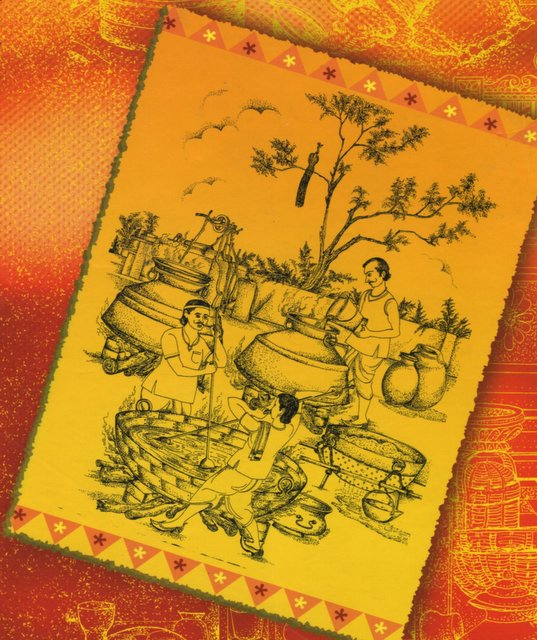
Illustration from front cover

Dadima no Varso which translates to "Grandmother's legacy", is a veritable tome of a book published by the Palanpuri Samaj Kendra. It was the brainchild of Nita S. Mehta, Rajul A Gandhi and Dr. Satyavati S. Jhaveri but it is the hard work of the 35 ladies that make up the Rachna group of women. When it came to chosing a name for the book, Dadima no varso seemed a logical choice, because the recipes were all collected from grandmothers.

What began as a cookbook to document speciality recipes soon grew into a guide to younger generations, encompassing every aspect of the communities culinary traditions as research revealed recipes and aspects of the cuisine unknown to the authors. "This is our contribution to society" says one of the ladies, "others contribute money, we have contributed our time.

And time consuming it was, with all the recipes being collected in the words of the grandmothers and measured in handfuls and pinches and then tested for exact measurements by the ladies of the group. Then with the book printed simultaneously in two languages - Gujarati and English versions of each recipe alongside each other - it also required close scrutiny by people with a grasp of both languages and culinary skills as well.

That this is a labour of love shines through with every page you turn. There are recipes for everything from celebratory dishes for festivals to fasting dishes for the Jain paryushan period and even mouth fresheners for the end of meals.

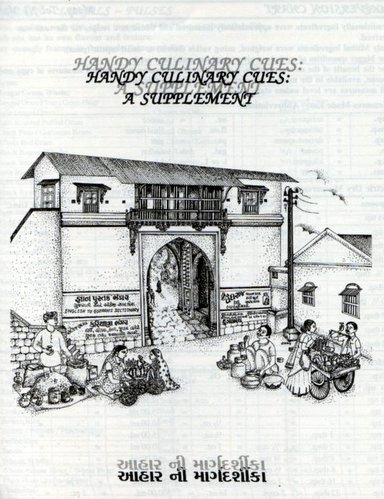
Illustration from back cover

There are color representations of every dish in the photographs in each section but in addition to this beautiful illustrations and line drawings by Ramchandrabhai Chauhan, an award winning artist augment the pages of this book, offering an insight into the traditioanal foodways and life of the Palampuri Jains.

Illustration from section header

Copies of the book are available from the Palampur Samaj Kendra,
151 Shanti, August Kranti Marg, Mumbai 36.
Phone 23632288
Posted by Picasa

Friday, September 29, 2006

Interview with Usha Prabhakaran author of Usha's Pickle digest

Interview with Usha Prabhakaran author of Usha's Pickle digest

Usha Prabhakaran is the self published author of "Ushas Pickle digest", "The perfect Pickle book" as it says on the cover. A thick volume of 365 pages, the book contains exactly 1000 recipes, is meticulously researched, perfectly cross-referenced and according to my friend Vikram Doctor food columnist with ETworth it for the multilingual ingredient glossary alone. (In fact it was Vikram who showed me the book almost a year an a half ago. He had found it at Landmark bookstores in Chennai.)

Always fascinated with the idea of pickles and its associated traditions - I was intrigued to hear of this extremely well put together book. Unfortunately by the time I went looking for it not a single book store in India had a copy left. I kept looking for the author, Usha Prabhakaran and her book off an on with the help of friends until we finally managed to get a number for her.

Untill the moment I called her I knew her as the author of an excellent book that had been self published (and anyone who has tried to sell a book to an Indian publisher will recognize that as a feat in itself) but after I spoke to her my respect and admiration became awe and inspiration. Not only did I find out that Usha had survived a fatal disease but she the disease had struck the day her book was published.

Here is an interview I have conducted of her via the internet and on the phone.

When did you decide to write a book on pickles and what made you decide to write a book about pickles?

Whoever had the opportunity of eating my pickles liked them very much and I found myself meticulously writing down the recipes for them. That is when the seed for a pickle book was planted in my mind. After all the pickle is a great subject to write about because it is compatible with almost any dish, can be easily adopted to suit available ingredients, countries and palates and following canons of pickling allows for them to be prepared without much difficulty. Also store bought pickles have preservatives added to them which can be avoided if the pickles are prepared at home which is an added advantage and of course home made pickles are always tastier, being made with first quality ingredients.

How did you go about your research, which were some of the people you spoke to?

Whenever and wherever I taste something new, I instantly approach the person that made it without any hesitation whatsoever and tell them how tasty their recipe was and ask if I could jot down the preparation method. My book is a tribute to the many housewives in general and to the Komitti Chettar community in particular, who generously and painstakingly shared their recipes with me, happy in the knowledge that the information they parted with will be documented and be part of a valuable pickle recipe book.

Did you learn anything unusual from any older person you spoke with during your research?

I found all the old persons as a rule very disciplined and fastidious. Pickling required that there should be no moisture of any sort in the containers, the vegetables should be dry, adequate salt should be added, the pickle should be steeped in oil etc. Experienced hands were extremely particular with vegetable, spice and oil selection, they used pickle jars that had been washed and dried in the sun and were particular about using home ground spices (chili, turmeric, asafetida, fenugreek etc. as much as possible doing the grinding themselves in many cases, no matter how tedious, or tiring, because they believed much of the end result depended on these things.

Is there anyone you spoke to in your research of recipes whom you will never forget?

Apart from my mom-in-law, I had a neighbor - a very close friend of my mother's – who taught me all I needed to know about Andhra pickling but I can safely say that I did not spare any person who I felt would add some value to my book.

What made you decide to self-publish?

Publishing a book means finding a publisher worth the name and finding one such is not that easy to come by, if the effort happens to be your first one. So I decided to go it alone – it gives you such a sense of pride and achievement, believe me. I have not for one moment regretted it, although the book would have sold faster with glossy pictures et al. and been a more economic deal with greater visibility, if published by an established publisher.

Did you have problems publishing your book? What hurdles did you face?

As already mentioned, the publishers I went to – the ones who you think you would like to be associated with - placed restrictions: time wise/other publisher-wise/money-wise etc. These were not things I could accept. Deep in my heart I knew, a good thing would speak for itself.

Why do you think pickling has been popular in India?

India is blessed with cheap and plentiful availability of a staggering variety of vegetables, fruits, spices and oils. It is no wonder then that pickling has always been popular in India. India being a hot country, hot spicy foods such as pickles which perk up any meal and whose diversity is well recognized are key features of Indian cuisine. This is especially true of South India. Pickles go well with rice, idli, dosa, chappathi (and all other Indian breads), puri, parathas etc. Naturally every community and every family has a tradition of pickling.

How did you become interested in pickles?

My mother-in-law hails from the Komitti Chettiar family, originally from Andhra Pradesh, with a long and highly regarded tradition of pickle making. After every visit to her place, I would return home with bottles of tasty, mouth-watering delicacies. I wanted to document these pickle recipes so that they would not be lost to posterity.

What have you found are some of the major differences between pickles from different parts of India?

Although mango is the preferred base vegetable for pickling, the fundamental variation is that in the north the pickles are made with chilly powder, turmeric powder, garam masala, vinegar or lime juice, sugar and mustard oil, while in the south, the same pickle is prepared with chilly powder, turmeric powder, asafoetida, tamarind extract or lime juice, jaggery and gingelly oil. In the north, east and west, the preference is for sweet and sour pickles. In the south, the sweet portion is hardly visible. Besides these pickles being made at home, no artificial preservatives are used.

In your research have you found any health risks related to pickled foods?

Pickled foods do not cause health risks. If a person is already suffering from ailments, she/he can be selective in the choice of pickles. In general because of the spices used in them, pickles stimulate the appetite, aid digestion, cool the system, cure cough and cold etc. You will be amazed at the highly spiced Andhra avakkai ( A.P) being consumed in enormous quantity, with little or no side effects. This could be attributed to the large consumption of ghee.

On the positive side, you have propagated that pickles can be effective in treating various ailments, Can you elaborate on that?

The spice and seasoning used in pickling have clearly defined attributes that help the body in specific functions. Spices are anti-oxidants, so they act as free-radical scavengers. Pickles contain essential oils that help to kill bacteria in the intestinal tract.

Ginger, asafoetida and turmeric are all considered digestives. They are pickled with beans or split peas to fight off their hard–to-digest stubbornness. Mint does the same thing. It also kills germs. Asafoetida is considered a nerve tonic; Cumin and green cardamom are cooling, clove and cinnamon are warming, ginger is good for the cold, raw garlic is good for circulatory ailments or jangled nerves, red chilies in small doses have antiseptic properties, black pepper promotes appetite and acts as a tonic for new mothers.

When reading your book you soon realize how many variations of food can get pickled. Was there any food that you were surprised to find in a pickle recipe?

Sure, I will give you an example. I generally look for great variety in food that can be pickled. I was truly amazed when I learnt that hibiscus flower is a good base material for pickle making.

Do you think it is important to preserve traditional recipes and food lore? If yes, why?

Indeed, there can be no doubt that traditional pickle recipes and food lore should be preserved. Pickling is an art and as in the case of all art forms, pickling is time consuming, but if left unrecorded, the recipes and the food lore that go with them will be lost to posterity. Traditional methods can often be laborious and time consuming, but the final product is tasty.

What are some of your favorite recipes out of your book?

Some of the favorite recipes from my book are small red onion in tamarind sauce (27), sweet and sour orange peel (30), plantain flower – hot (32), stuffed kalakkai chain – oil less (70), curd gooseberry – green chilly- watery (490).

What was the first pickle you made?

Mango-ginger was the pickle I experimented with first and most of my friends still love it. It is easy to make, the peeled slices of mango-ginger are combined with chopped garlic, a few strands of green pepper and tossed in salt and lemon juice. The pickle required frequent turning to prevent spoilage and lasts for up to 10 days at room temperature and about a month in the refrigerator.

Which is your favorite pickle to make now?

Gooseberry pickle in whipped curd is a pickle I like to prepare. All you have to do is whip up some curd (yogurt) with turmeric powder, salt and a generous amount of water and whip well again, steam the gooseberries and remove their segments, reserve but discarding the seeds. Heat oil and season with mustard seed, green chilly, curry leaves and stir into the whipped curd mix. Add in the gooseberry segments and mix well. The pickle can be used after a few hours and stores well up to a month in the refrigerator.

What is your favorite pickle to eat, do you like sweet pickles, spicy ones or sour ones?

I love spicy pickles with a dash of sweetness and sourness. I don't much fancy sweet pickles and I love the Methi sprouts pickle because it's health-giving properties. Methi seeds are soaked in the water for about 8 hours then drained and wrapped up in a damp cloth. The cloth is to be constantly moistened, to ensure that the sprouts appear. When the sprouts reach the desired length i.e. 1cm. approximately, the sprouts are pickled with tamarind extract, chilly powder, turmeric powder, asafoetida powder, jaggery and salt boiled in oil. The sprouts are to be sautéed for a very short time, because otherwise the pickle will become bitter.

Which was the most unusual pickle you come across in your research?

On a visit to the home of one of my husband's relatives I was told that I could create a great pickle out of curry leaf seeds. I tried it out and found it out to be out of this world. Not only was it delicious, it is also rich in vitamin A & D, and good for hair growth.

I know you are working on your second book on Rasams. Could you tell me more about Rasams?

Rasams are usually watery sometimes thicker, concoctions made from different vegetables, fruits, grains or combinations of these, with the addition of cooked dals and seasoned with ghee or oil. The seasoning normally contains a few spices like mustard seeds, curry leaves, asafoetida, cumin seeds etc. There are rasams prepared from grains, plain and sprouted, leafy greens, herbs, vegetables and fruits.

When will the book be published?

Usha's Rasam Digest is likely to be published in 2 months' time.

What are some of the interesting recipes you have covered in it?

You would be surprised to find rasam being prepared from waste vegetable materials like peas pods of fresh green peas along with ginger, green chilly and onion, addition of powdered pepper and cumin and seasoned with cumin seeds and crushed garlic seasoned in ghee.

Unripe tomato rasam is a favorite with me. When we utter the word rasam it conjures up images of a ripe tomato in tamarind sauce but this is not the case here. Here the rasam with tender green tomato is pressure-cooked with toor dal, turmeric powder and gingelly oil. Later, the rasam mix is boiled with rasam powder, salt and seasoned with mustard and asafoetida powder fried in ghee.

What advice do you have for people who wish to write a book and self publish?

Writing keeps the mind active and writing or working on a subject one likes does not tire a person too much. Self – publish one must because, although it costs a little more, one can be proud of it at the same time.