Monday, June 23, 2008

Author Interview - Ammini Ramachandran, Grains, Greens and grated coconuts - Recipes and Remembrances of a Vegetarian Legacy.


Ammini Ramachandran took a rather meandering route to the world of food writing. After clocking in over two decades in a career in finance, She now spends time researching, cooking and writing about the cuisine and culture of her home state of Kerala in India. In March 2007, she published Grains, Greens, and Grated Coconuts: Recipes and Remembrances of a Vegetarian Legacy. An excellent book that went on to receive endorsements from several well known food writers around the world and be celebrated by the New York times.

RMG: Tell us a bit about your background.
AR: I was born and raised in Kerala and moved to the United States in 1971. A chemistry graduate from Kerala University, I studied finance in the United States and received an MBA from Southern Methodist University in Dallas, Texas. I worked as a financial analyst in international banking until 2001. I took a rather meandering route to the world of food writing. Writing was always my hobby. After Sep 11, 2001, I took early retirement and decided to pursue writing. After spending over two decades in a career in finance, today I spend my time researching, cooking and writing about the cuisine and culture of my home state Kerala.
RMG:     How did you become interested in cooking?
AR: I got into cooking out of sheer necessity. When I came to the US in the 1970's, there were no Indian grocery stores in Rhode Island where we lived. The closest store was in New York City, some two hundred miles away. Vegetarian food was not popular in America at that time. Being a strict vegetarian, I had to learn to cook in a hurry if I wanted to eat Indian dishes. My mother's letters that came every week in the mail always contained a couple of recipes.  I learned to cook by referring to these recipes. During my many trips home, I learned more recipes from her and my extended family.  
RMG: When and how did food and its exploration become important?
AR: Today with most of the younger generation in my family living in the United States, I wanted them to remember the food prepared at their ancestral home, its history, and culture and started writing a family journal. After reading the initial drafts, the feedback I received from them, as well as their American friends, was most encouraging - They all wanted to read more about our history, and stories about our food.  This encouraged me to explore more about of food, history and culture. 
RMG: Why "Grains Greens and Grated coconuts?"
AR: A straightforward cookbook with only recipes was not my intention in writing this book. And so I did not want to give it a title that ended in "cookbook". When writing a book that brings the threads of history, geography, religion, tradition, and personal history together to present the food of my region in Kerala, a just recipes only book was not the way to go. Grains (rice and dals), greens (vegetables) and grated coconuts are the crucial ingredients in this cuisine and I felt that it would be an appropriate title.  
RMG: You have obviously given every aspect of the book meticulous attention. What were the criteria by which recipes went into your book?
AR: It was a very simple criteria- recipes for all the food that was cooked in my extended family, dishes that are traditional to the Hindu homes of central Kerala. This book by no means a complete collection of all Kerala vegetarian recipes. Several northern and southern Kerala recipes as well as specific vegetarian recipes of the Christian and Muslim communities of Kerala are not in this book.  
RMG: What made you decide to write a cookbook?
AR: As I said above I started a family journal documenting the culture and cuisine of Kerala.  After Sep 11, 2001, I decided to take early retirement from a career as financial analyst and decided to concentrate on writing about Kerala's food and culture. Slowly my family journal evolved into a web site - peppertrail.com and then to this book.   
RMG: Did you look to other cookbooks for inspiration?
AR: Most certainly I looked to several cookbooks for guidance. Ever since the late 1990's there is a growing interest in the United States in cookbooks that present ethnic cuisines against a backdrop of culinary history and culture. These titles also bring cuisines of the world into the modern kitchen in the form of balanced, unusual, and tasty recipes that are within the reach of any cook.  
Among these the truly exceptional and inspiring to me were - Frida's Fiestas: Recipes and Reminiscences of Life with Frida Kahlo, by Guadalupe Rivera and Marie-Pierre Colle, Splendid Table, by Lynne Rosetto Kasper, Gefilte Variations, by Jayne Cohen, and Italian Festival Foods, by Anne Bianchi, and The Food and Life of Oaxaca, by Zarela Martinez. My ambition was to write a book in a similar format about the practically unknown vegetarian cuisine of Kerala.
RMG: How did you set about working on this book?  Did you travel, meet people?  Spend hours in your own kitchen?
AR: How does a financial analyst go about writing a cookbook?  Of course I started with an excel spread sheet listing the various recipe categories – every day dishes, festival dishes, seasonal dishes, recipes that are special to my family. Then came sub categories – curries, dry vegetable dishes, pickles, chutneys- the list goes on.  A second spread sheet detailed who to contact for particular recipes.  
I already had a collection of recipes from mother. I taught myself to cook by referring to the recipes that my mother sent me every week in her letters. During my many visits home I also studied this traditional cuisine from native cooks who have lived and cooked in our region their entire lives. I have spent many fascinating hours listening and writing down their verbal culinary histories that go back hundreds of years. I also spent many hours researching about ancient Indian Ocean trade and its impact on Kerala's cuisine and culture.
Writing a book on Kerala cuisine, while living thousands of miles away from there, also posed a problem. It was especially difficult to reach older relatives via phone to ask any questions. So I enlisted the help of a research team - My sisters Girija Narayanan and Rathi Ramachandran and my cousin Usha Varma, my very patient research team, spent many hours collecting and writing old recipes and the oral history of our cultural traditions. I could not have finished this book without their help. This is as much their book as it is mine.  
Then came the recipe testing phase. While following my mother's recipes I had inadvertently followed her method of measuring ingredients by pinches and handfuls. Purchasing sets of measuring cups and spoons and redoing her recipes with measured quantities of ingredients was the next step- which needless to say took many months. Initially often I would forget to measure an ingredient midway through cooking, and had to start all over again. That was the most frustrating part of this phase. When it was impossible to find certain seasonal ingredients in the United States, again came my sisters and cousin to the rescue. They tested the recipes and reported back.    
Meanwhile I attended conferences and symposiums for food writers and took continuing education courses on food writing from the food studies department at New York University. I joined several professional organizations for food writers - International Association of Culinary Professionals, Slow Food USA, and Culinary Historians of New York. Through these organizations I learned about the "science" of recipe writing (how each recipe has to be organized beginning with the first ingredient you use in a recipe) and the value of head notes to recipes.   
RMG: Would you share some of your most pleasurable moments during research, interactions with cooks, food tastings, learning to cook?
AR: It was very amazing for me to see how the home cooks I spoke to responded with enthusiasm when I showed genuine interest in their recipes and cooking methods.  
There is young woman Lakshmi in my home town who cooks every day meals to a few elderly people in the neighborhood for a small fee. She also takes orders for snack foods and spice mixtures. All of the cooking is done in her own kitchen and she and her husband deliver the food. Her food is simple and delicious. My mother always asked her husband's aunt used to come and make the snack murukku in our home. Making this snack by hand is a dying art today. One day I went watch Lakshmi make murukku by hand. And we chatted as she sat on the floor twisting the dough into multi-layered circles of curly spirals on the cotton cloth spread on the floor. She asked me about how I cooked Indian food in America and what vegetables and fruits were available in the USA. I mentioned that good jackfruit is hard to come by and the best we could do is to use canned jackfruit from Thailand.  
I am a huge fan of her sambar powder and I had placed an order for it to bring it back to the USA. The day before I was leaving she came with a package. I did not get a chance to open it immediately. Later that evening when I was packing my bags I opened the brown paper bag, I was surprised to see a small stainless steel container inside. I opened with curiosity and it was full of homemade jackfruit jam, glistening with a coating of ghee. How thoughtful of her!  
RMG: What was most enjoyable about the process of writing your cookbook?
AR: Researching, writing, editing and publishing - it was a long haul. The enjoyable about the process was the satisfaction that I am finally getting around to documenting the food and culture of my community.  But the most enjoyable part came after it was published. I connected with so many wonderful people through this book. After an excerpt and a recipe were posted on Anothersubcontinent.com, the members started a thread devoted to 'Cooking with Grains, Greens, and Grated Coconuts'. Many of them posted photos of recipes they prepared, with Kavitha Ravi from Malaysia taking the lead to make sure that every single recipe was cooked, photographed and posted. The thread has evolved into an online full-color pictorial companion to the book's recipes.  
When the book won the Cordon D'Or award for best self published cookbook, I traveled to St. Petersburg for the award ceremony. And there was arunr (whom I had never met before), a member of anothersubcontinent forum, at the airport to welcome me. Although the award ceremony was held as a fund raising event for Abilities Foundation, arunr got special permission from the organizers to take my photograph as I received the Award. And before I got back home he had already shared the pictures on the forum thread.   
It is so touching when people I have never met in my life write to me after they have read the book. One young woman wrote how grandmother cried with joy when she prepared ela ada, a typical sweet prepared for Onam festival. From a young Kerala woman from Dubai to a retired professor from Canada, I have met so many wonderful people because of the book.  
RMG: What's your favorite recipe from your book?
AR : It is hard to pick one recipe as my favorite. Ellukari, the sweet, sour and mildly spiced curry with a fragrance of toasted sesame seeds and coconuts and chethumaangakari- the spicy hot green mango pickle are definitely two of them.    
RMG: What were some of the things you were uncompromising about as regards to your book; that you think should be given more attention in other cookbooks? (Language, recipe testing etc)
AR: I believe that in her New York Times article Anne Mendelson really summed up about the things I was uncompromising as regards to my book. She wrote: "Instead of trying to cover all menu bases that an editor might insist on, Ms. Ramachandran is free to concentrate on unorthodox categories, including amazingly diverse "curries" (sauced vegetable combinations), pickles and preserves, breakfast specialties, rice dishes associated with sacred observances and temple or rite-of-passage offerings. Other books have ably explored India's far southern territory, but Ms. Ramachandran reveals amazing range and depth in Kerala's Hindu vegetarian traditions. And American home cooks should find her introductions to ingredients, techniques and equipment accessible".
Regarding other cookbooks, each book is a personal journey of the author. Publishing houses have the final say and they often dictate how the content should be presented. It is up to each author to decide how and when they should compromise to these demands.
RMG: How do you determine your book's success, so far?
AR: The success of the book so far has been in receiving good reviews. Sales are alright, nothing fantastic. This is mainly because most sales are only through the internet.  Only a few specialty cookbook stores in the Unites States and Canada are carrying the book. This is because iUniverse do not accept returns and offer smaller discounts to booksellers. I hope this will change with the Star edition. Star editions offer industry standard discounts to booksellers and books are returnable.  
RMG: Anything you would have done differently?
AR: Of course I would have loved if a publishing house had picked up the book. Then again, I would not have had the freedom to include all of those historical facts and personal anecdotes.   
RMG: What next? What can we, as your fans, look forward to next from your kitchen/pen?
AR: I continue my research on Indian Ocean spice trade and the food history of south India. It was a pleasant surprise for me to learn about the tremendous interest people in the United States have in learning about Indian Ocean spice trade. At every presentation I make, I get more questions about this topic.  I also continue to write about this topic. I have contributed to two forthcoming publications - Encyclopedia on Entertaining through Time and Cultures to be published by Greenwood Press and Storied Dishes: a book with fifty women food writers donating recipes and the story/memory behind the recipes. 
RMG: Lastly, is there anything else you can tell us about yourself, your career, or the profession that would be interesting or helpful to others aspiring to write a cookbook?
AR: I have only a simple advice for aspiring food writers. Never give up your hope. Road blocks are many in the world of publishing- but if you have your heart in it, you will find ways to work around them.  

Book is currently available through amazon.com, barnesandnoble.com, and iuniverse.com. It would be wonderful if major book store chains in India would carry it when the Star title becomes available through international distributors at industry standard terms. 

Thursday, June 5, 2008

Pictures of our lunch in Vasai


Lunch -which I was supposed to help cook... well I did manage to stir the curry before I put it on the table - consisted of pomfret done two ways; in a curry of coconut juice flavoured with the ubisquitious bottle masalla and local cane vinegar, and also two rather large specimens stuffed with coconut chutney and pan fried in banana leaves (a dish I found very reminiscent of Parsi Patra ni machchi, couldn't help wondering if there is a common root to that dish) all eaten with rice. (I have pictures of this bit but bear with me, because they are on my phone and my phone and my computer are not on talking terms currently! )

The seasoning in the food was less than what we eat at home, but that was a good thing because it allowed us to taste the delicate flavours of the fish and the curry it was cooked in. Bessy fried the rest of the chutney she'd stuffed the fish with, in a tempering of Mustard and Curry leaves. Lunch was delicious. Generously seasoned with hunger, the tangy slightly spicy fish curry came together beautifully with the chutney that tasted of fresh coconut. We ate a lot, quickly and with our hands, the next bite being ready to enter our mouths before we'd finished with the last and were still picking morsels of plates and spoons long after our stomachs were full.

Sunday, June 1, 2008

Making East Indian Bottle Masalla for My Mumbai Cookbook


The East Idian chapter of My Mumbai Cookbook will actually come up much later in my writing schedule but the legendary Bottle masala is only made this time of the year (January to April). It also has a 'secret recipe' so when I found a friend whose mom was ready to share the making of it, I grabbed the chance. I surmounted all odds to get there the stipulated weekend, planning things down to the 'p', prepacking on Friday, borrowing moms car (ours was in the shop). And I am so glad I did because the monsoons arrived in all their glory the very next week!


We'd planned to leave by 10 but I only woke at 8:45 when Bessy, the friend I was supposed to visit called to ask if we had left! A mad rush ensued as I pushed husband and son to get dressed and got baby and myself ready as well.


The Ghildiyal family, with assorted baggage, baby gadgets and actually left home in record time. (Well 11.00 was not bad since we had planned for 10.00 all things considered.) I am coming to a conclusion after Natasha was born that babies come with a Murphy's law chip embedded in them. That is why they will choose to poop the exact minute you step out of the house? Trow up the exact minute you finish buttoning them into their new dress OR and this is a classic.. Poop the moment you've changed them into a fresh diaper.


We arrived at our friends (the Machados) Vasai home in time for lunch and all of a sudden the mad rush seemed to slow down as beer cans were popped open and the men got comfortable in front of the cricket match on TV, while keeping an eye on the kids (my 2 and Bessy's 2) while us women got busy in the kitchen.


Lunch -which I was supposed to help cook... well I did manage to stir the curry before I put it on the table - consisted of pomfret done two ways; in a curry of coconut juice flavoured with the ubisquitious bottle masalla and local cane vinegar, and also two rather large specimens stuffed with coconut chutney and pan fried in banana leaves (a dish I found very reminiscent of Parsi Patra ni machchi, couldn't help wondering if there is a common root to that dish) all eaten with rice. (I have pictures of this bit but bear with me, because they are on my phone and my phone and my computer are not on talking terms currently! )


The seasoning in the food was less than what we eat at home, but that was a good thing because it allowed us to taste the delicate flavours of the fish and the curry it was cooked in. Bessy fried the rest of the chutney she'd stuffed the fish with, in a tempering of Mustard and Curry leaves. Lunch was delicious. Generously seasoned with hunger, the tangy slightly spicy fish curry came together beautifully with the chutney that tasted of fresh coconut. We ate a lot, quickly and with our hands, the next bite being ready to enter our mouths before we'd finished with the last and were still picking morsels of plates and spoons long after our stomachs were full.


After that sumptuous lunch, a nap was on the cards, we were in Vasai after all, where afternoon naps after a big meal of fish curry and rice are de riguer.


At 5 going on 6 (are you surprised?) that evening, Riki, Bessy's husband dropped us off to Bessys moms house while my husband valiantly babysat the kids. Thank god for him, because without his support, the next few hours of idyllic culinary exploration could not have been possible.


It was in the next few hours that Bessy's mom, Mrs Margaret Nunes was going to teach me how to make Bottle Massala, Sorpottel and Vindhaloo.


But before I get into the details let me tell you about East Indian Bottle Masalla. This magical spice mix is a bit like the legendary Ras el hanout, it seems to have every spice in the world in it, only as opposed to being made by merchants it is made by women at home and each home has a separate recipe. It is then used round the year to distinctively flavour East Indian cuisine. It goes into everything!


The making of this Bottle masalla is an annual event amongst the East Indian community. The annual supply is made and put down just prior to the monsoon when hot sunny days are guaranteed and used round the year.


Bottle Masala travels far and wide, with members of the community carrying it with them so they can replicate flavours of home in far off lands.


Like all Indian spice mixes, the spices for this masala are also dried in the hot sun, then each is individually roasted over a slow fire and either in a mortar and pestle or processed like the one I made in Vasai. Once we had roasted everything, it was all mixed up and taken to the local flour mill where it was ground in a special mill reserved for grinding masallas.


The resulting powder was left to cool down completely and then tightly-packed in air-tight, dry bottles (now plastic but beer bottles were once the container of choice which is how the masalla came to be called bottle masalla). The bottle is then properly sealed and will last a long time if kept away from sunlight and moisture.


Tuesday, May 27, 2008

My Mumbai Cookbook – the story so far and the blog

I once cut a million teeny - weeny happy faces to put in a letter to a friend who was ill so that he would open the envelope and have them fall all over and perhaps bring him some happiness.


I have never been able to do anything on a small scale…

As an art student at school, I always chose the largest canvases to fill, later in animation school the story idea I animated involved several backgrounds that required the making of a million miniature hats, as an operations executive with my mothers company I would design elaborate itineraries embellished with clip art of beds and dishes of food to illustrate bedtimes and mealtimes, still later as a candle maker I was the recipient of my sisters curses because all my candle designs were labour intensive requiring me to spend hours creating miniature scenes that would then be filled with transparent gel wax to become stories frozen in time.


But whatever I chose to do, I worked at it until it was the best I could do.


Where others would avoid activities that require that much labour, I gravitate to them.


Ever since I began writing on food, I have written a lot of articles I loved working on, become pretty good at food styling and improved immensely as a cook but I hadn't done anything big.

But, to be fair, I wasn't really looking.

And then, almost in a thrice, the idea for "My Mumbai Cookbook" came to me. It clicked in the way that things that are meant to be click and has been clicking ever since.

'My Mumbai Cookbook' to put it simply is a diary of culinary experiences written by a food lover who measures her life in the meals she has eaten. Not in meals eaten at restaurants but the meals we come home to. Meals made in by women who love us. And My Mumbai Cookbook is not just about the food it is also about the places we get the food and the people that make that food, women (mostly) who run the home kitchens of Mumbai.

Today as I begin to write this book I am aware of the huge canvas I have to fill and I am looking forward to the every step of the journey of discovery.

Which is why I decided to blog about my experience of writing the book.

I know a million interesting experiences await; a whole lot of little side trips I know I will end up taking that probably won't make it into the book and it seems appropriate since blogging is where my journey as a food writer began…

(Needless to say My Mumbai Cookbook - the Blog about writing the book will have none of the content that will go into the book (not for now anyway).

My Mumbai cookbook is part memoir, part food guide and wholly a cookbook. It will offer a smörgåsbord of cuisines in the same book so the foodie or food traveler can get a sampling of Mumbai because Mumbai is not just about one cuisine, but is a melting pot of many. After all food has a way of crossing the divide of community and religion and over the years this has resulted in a variety of cuisines, aromas, flavours and tastes all combining into one huge melting pot that is Mumbai.


Thursday, February 7, 2008

Foodwriting as a career in India for Me Magazine

Whenever I introduce myself as a food writer I am usually asked “What’s a food writer?”

I recall the first time the question came my way, I simply blurted out the obvious, “A food writer is someone who writes about food” and went on to elaborate on the kinds of articles I wrote and the magazines I had been published in. But the episode comes back to me. After all, how would you answer that question right now?

Good question!

Even Wikipedia does not seem to have an answer.

BUT according to Wikiedia “Food is any substance consumed by living organisms, including liquid drinks. Food is the main source of energy and of nutrition for animals, and is usually of animal or plant origin.” And Writing is defined as “a process which may refer to two activities: the inscribing characters on a medium, with the intention of forming words and other lingual constructs that represent language and record information, or the creation of information to be conveyed through written language.”

So FOOD WRITING could be defined as “the inscribing characters on a medium, with the intention of forming words and other lingual constructs that represent language and record information, or the creation of information on the subject of any substance consumed by living organisms, including liquid drinks to be conveyed through written language.”

Umm… I think I will stick with FOOD WRITING is writing on food. I can hear you going “DUH” at me but try having to explain what you do at least once a day (at the very least) to a PR rep for a restaurant, a publication or just about anyone else and you will sympathize…

This is because food writing is still to a large extent an undefined sector in the publishing industry in India.

On the global scale Food writing has come into its own. Categorized under the larger umbrella of writing in general it has it’s niche and covers everything from articles for print and web to books related to food. It encompasses subjects ranging from food (and drink) production to consumption. That said there are branches within food writing - some food writers choose to stick to certain areas like restaurant criticism – in which case they would be restaurant critics, or wine in which case they would be wine writers or wine critics.

Conversely food writing is an undefined, unrecognized sector in the publishing industry in India. There are less than a handful of food writers about, no formal training courses and even today few publications recognize food writers as specialist writers. In fact Food writing in the true sense of the word is unexplored and books on food are at a very rudimentary stage of evolution. Food writing has a long way to go toward achieving the cult status it enjoys in the West. There are very few food writers in the true sense and no formal training courses. So each step of my journey has been one of learning as I went along.

So does one need to have a specific background or training in order to be a successful food writer?

It will come as a surprise but most food writers and food critics ended up in this field after working in other areas of writing or in another career altogether… Jeffrey Steingarten, the food writer for Vogue, was a lawyer in his past career, Ruth Reichl, Editor in Chief of Gourmet magazine, worked in and later owned a restaurant and closer to home restaurant critic Rashmi Uday Singh author of the Times good food guides was Deputy Director General, Shipping with the, Indian Administrative Service, before she gave it all up to be a food writer.

I take comfort from all these stories because food writing happened entirely by chance for me. I discovered food writing while on a sabbatical from my job. As the mother of a toddler I was pretty much confined to my home and the internet was my lifeline to the world. I spent hours surfing the net and reading about all sorts of things and experimenting with blogging. It was at this time when I was looking for information (on pickles I think) that I discovered egullet.org home to like minded people who reveled in food. I spent weeks dithering around, lurking through its forums, scribbling a line or two here and there until I finally worked up the courage to put up an essay on Uttarakhandi Cuisine. The cuisine in question being unknown, my post got a lot of attention and my inherent talent for research and writing must have come through because I got a lot of praise. The post was the first step to a book that is awaiting publishing but more immediately it brought me a job offer with a local gastronomy magazine and made me realize that perhaps there was a career for me in food writing.

The first realization a food writer must have is that food writing is not just recipe features or restaurant reviews. It goes beyond that. Food writing like all other writing aims to stimulate the senses of the reader either evoking experiences, past or present or more practically motivating the reader out of the armchair and into the kitchen or nearest restaurant.

Not willing to give up being a hands-on mother, I chose to freelance. My first article (not surprisingly) on Utterakhandi cuisine was published in April 2005 in Savvy Cookbook. By June that year I had 3 articles published including an essay on Kutchi food, a recipe feature and a restaurant review, each in a different publication. In retrospect free lancing was the best decision I could have taken because it allowed me to work on a variety of subjects and styles and amass a body of work that I would not have been able to if I had been with just one publication.

Three years down the line today I have more than 400 articles and share viable relationships with at least 12 publications.

When you are starting out it is a good idea to try everything but be wise and use that phase to identify your strengths as well. For instance I prefer to circumvent restaurant reviews and other generic articles. These are easy to write but my approach to them is of a “have to get this article out” sort of attitude as opposed to my usual feeling of eagerness that subjects I gravitate towards inspire. I have found that articles that motivate me are ones that deal with subjects closest to my heart; the food on the plates of real Indians, culinary history, the migration and evolution of cuisine, sustainable agriculture, the intersection of food and culture, food as a carrier in the evolution of a culture (preferably researched at the knees of someone’s mom or grand mom) and my India is a rich country for that.

That said however do focus on your niche once you have identified it. Food writing is relatively unknown in India - I am still slotted under freelance writers at most publications. As a result I am often asked if I could do a story on this or that “just this once”. I did a couple of these in my initial days but stopped when I realised I spent twice the amount of time researching unknown subjects. If you have decided to be a food writer, FOCUS on food writing. Sticking to your niche might lead to lean pickings at the outset but it will pay off in the long run. Once your by-line comes to be associated to one kind of topic and your prowess with the subject comes to the fore more “meaty” assignments will come your way.

I made Rs.1000 for my first assignment. I then spent the ensuing year accepting whatever came my way, regardless of remuneration. One year down the line however, I began to let go of low paying assignments because I found that these were the hardest ones to do. I also began to develop relationships with quality publications. You might need quantity in terms of bylines at the outset of your career but once you are established it is the publication you associate your name with those that count and believe me, the good ones rarely have qualms about paying fairly!

Most of us shy away from appearing avaricious. We are uncomfortable asking for more money. At times like this try to remind yourself that you are having that dialogue about money because the person at the other end feels you are worth pursuing. (let me share a secret here, I don’t stress about appearing greedy ever since I realized that it helps separate the wheat from the chaff!) Once you have work coming in, losing a quickie job that pays too little isn’t a bad thing, it just frees up time for you to write the kind of stuff you want to – paid or not!

Food writing has ups and downs, the best thing is being forced to try new things. Last week, working on an article, I had a great time discovering the amazing variety of green leafy vegetables we use in Indian cuisine (I found 7 in Mumbai alone). I made three new dishes with them; an Irani mixed greens offering called Gormeh subzi, a forgotten Gujarati recipe called Dakho and a concoction all my own combining greens and dals. It was heavenly, but I would never know without trying it all. Food writing is a field that requires constant educating and re-educating. I study nearly every day to keep up with trends and food facts. I inhale every bit of food writing I can get my hands on, have about 500 books on food, encyclopedias and histories of foods and food names. The worst time I have had as a food writer is recently while I was pregnant! With a more adventurous palate I had more exotic cravings as well!

It takes hard work, dedication, perseverance, research, knowledge, an open mind, the ability to multi task and above all passion and creativity to grow as a food-writer but It's an excellent job for someone with a passion for food, writing and learning.

A FEW TIPS

It is important to write properly - When you send in an article, make sure it’s letter perfect. I thought I was a skilled writer until Naresh Fernandes editor of Timeout pulled me up for not spell-checking! He also recommended investing in a copy of Strunk and White which has held me in good stead when i am unsure of something.

Don’t wait for deadline - You can be an excellent writer but not meeting deadlines makes you unreliable. Also your editors are juggling lots of things so if you can send your work in early , do so, I have always found appreciation coming my way when I filed a story before time.

Ensure your information is complete - Do not leave anything to be desired. At the same time strike a balance with information, over loading your reader and making your editor work overtime will not get you more work!

Know your subject - I once accepted an asignment on Japanese cuisine, a cuisine I had never sampled. The publiation never used it. It had no passion. Write on subjects you know, i have found I can write well even on yams if I have experiencesd them. Besides if you are called to discuss your story idea you must be able to. Nobody is going to trust you with an assignment unless they are confident in your abilities.

Understanding your reader - If you’re writing recipe features for a woman’s magazine that is targeted at homemakers – an audience that juggles a budget ands cooks upto 3 meals a day - an article on innovative ways with Daal or quick microwave recipes rather than something like Truffles will be the order of the day, Truffles are better suited to the glossy, lifestyle magazine where your subjects must be in step with culinary trends around the world. You have to be in tune with your reader. That’ll help you identify appropriate ideas for your audience.

Be patient - Okay, you’ve spent hours, sometimes even days, developing story ideas, and if you are like me chances are you’re going to want a response RIGHT NOW. BUT hold on, remember that editor receives tons of similar mail. Every editor I’ve ever worked with has responded in due course. If you don’t hear back in 2-3 weeks then by all means e-mail or phone but keep it short. (Until I got confident enough to wing it on my own, I actually wrote out exactly what I would say over the phone). No extra chitchat, to the point. Remember you’re not trying to make a new friend; you’re trying to get work.

Develop a distinctive voice. This is perhaps the hardest to achieve. Voice is the unmistakable sound, rhythm, and point-of-view that connects with the writer so you know whose written it when you read it. Read writing by M.F.K. Fischer, Nigel Slater and closer home Chitrita Banergee, Vir Sanghvi, Vikram Doctor are people with a voice. When you’re reading them you can hear the authors' voices in your head. And more importantly, you can never confuse or interchange them. Unfortunately, most of us aren’t inherently interesting enough or big enough personalities to pull it off, as these masters do, most of us have to work at finding and developing our voice. But when you succeed, editors will use you again and again. Readers who have read me from my earliest articles might agree that I finally seem to have found my voice. I was inspired by the Laurie Colvin whose books I discovered recently.

Create your own website or blog. The fact is your own space on the web works. And with push button publishing you can do it with a blog, they are free. I include a link to my blog when I introduce myself to a new editor. Even if the assignment does not come my way, they do register me and my knowledge. Until you collect enough published work, the site will also make a good platform for your capabilities.

BOX ON FOOD WRITING CLASS

And then you can also thing of taking classes to augment your talents. Last year I took an online food writing class with Pamela White, publisher of the only periodical that focuses on food writing. In six online lessons, students learn to pitch columns, write articles, query magazines successfully, review restaurants, and write food essays and memoirs. Bonus chapters include tips on styling and photographing food, essential information on copyrights, selling rights and trademarks, and insider advice editors want writers to know. Each lesson includes assignments that guide the writer to successfully understand the lesson. Pam has now turned her original food writing class into a self-study course. "Make Money as a Food Writer in Six Lessons" Information on her course and book is available at http://www.food-writing.com/


Wednesday, October 24, 2007

Looking forward to American Masala


I see that Suvir's new book is out and I am looking forward to getting my hands on a copy.

His first book Indian Home Cooking: A Fresh Introduction to Indian Food holds its own on my bookshelf, but to be honest I bought it more out of curiosity than to actually cook from it. I had interacted with Suvir on various food forums and also tried his recipe for Tomato Chutney with excellent resuts so I wanted to see what the book was like. The book did not have too much in terms of new unusual recipes, some of the more unusual ones like the Shrimp Rasam and Lamb Biryani with Orange and Whole Garam Masala are now regulars on my recipe list. Indian Home Cooking has also become my favourite book to give novices to Indian cuisine as gifts. It very succintly lays down the basics of Indian food philosophy and the recipes are laid out for a western reader using recies that could be found in most western supermarkets.

But his latest offering, American Masalla promises to be a culinary adventure. I have observed how innovative Indian cooks are with local ingredients from my wanderings on Another Subcontinent and Egullet so I am sure that this book will offer some interesting ideas. I can't help looking forward to it much much more, unfortunately with the baby 10 days away, I will likely have to wait a while before i can get a copy! But with the hiatus I will be on then, I will have more time to try out recipes so untill then I shall console myself by trying this recipe for Chicken Harira from the book that Suvir has on his blog.

At the moment it is not available in India but can be ordered from Amazon.

Rushina

Monday, September 24, 2007

Book on the cuisine of the Planpuri Jain Community Dadimano varso - (Grandmother's legacy)


Everybody knows Gujarati Cuisine is distinctively vegetarian. With about 65% of the state's population shunning meat it has to be, but it's culinary versatality is legendary. A versatality underlined in the number of regional cuisines found within the state itself. One such regionally distinct cuisine is that of the Palanpuri Jains.

Jainism teaches that every human is responsible for his/her actions. It believes that all living beings have an eternal soul or jīva and insists that Jains live, think and act respectfully, honoring the spirit of all life. Jains view God as the unchanging traits of the pure soul of each living being and nonviolence extends to every aspect of their lives including their culinary practices.

Jains go beyond just shunning any kind of meat, their stance on nonviolence proscribes even food obtained with unnecessary cruelty. Observant Jains do not eat, drink, or travel after sunset (which is called Chauvihar) and always rise before sunrise. They do not eat root vegetables like potatoes, carrot, radish, ginger, sweet potato, white yam, because to obtain them is an unnecessary of the life of the entire plant. Garlic and onions are shunned as they are bulbs that germinate into plants.

Other foods like Brinjal, cheese, cream, honey, raw milk and yoghurt, stale food (because eating such food involves the killing of various kinds of microscopic creatures and germs) are veiwed as generative of life and so eating them amounts to violence, fruit salad, ice‑cream, fruit‑yoghurt combinations and all antibiotic medicines are prohibited. Infact even green and raw vegetables are prohibited on certain days and many Jains choose to be vegan due to the violence of modern dairy farms.

While the jain community all subscribe to similar food proscriptions there are regional differences amongst them as well. With the area of Palanpur being closer to Rajasthan, the proximity manifests itself in their cooking with increased use of ghee.

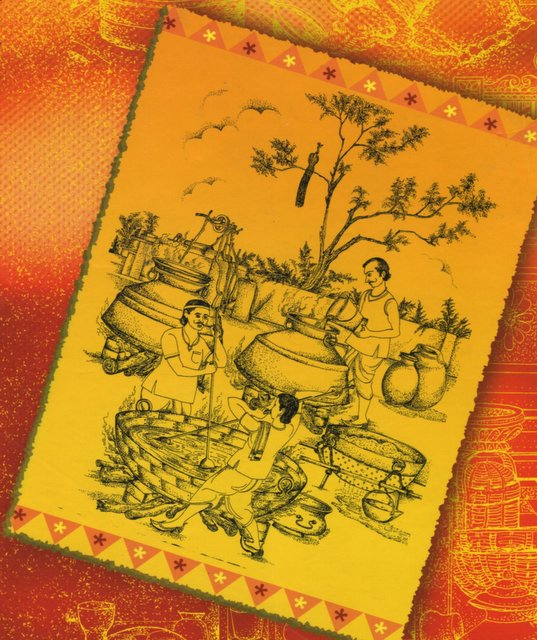
Illustration from front cover

Dadima no Varso which translates to "Grandmother's legacy", is a veritable tome of a book published by the Palanpuri Samaj Kendra. It was the brainchild of Nita S. Mehta, Rajul A Gandhi and Dr. Satyavati S. Jhaveri but it is the hard work of the 35 ladies that make up the Rachna group of women. When it came to chosing a name for the book, Dadima no varso seemed a logical choice, because the recipes were all collected from grandmothers.

What began as a cookbook to document speciality recipes soon grew into a guide to younger generations, encompassing every aspect of the communities culinary traditions as research revealed recipes and aspects of the cuisine unknown to the authors. "This is our contribution to society" says one of the ladies, "others contribute money, we have contributed our time.

And time consuming it was, with all the recipes being collected in the words of the grandmothers and measured in handfuls and pinches and then tested for exact measurements by the ladies of the group. Then with the book printed simultaneously in two languages - Gujarati and English versions of each recipe alongside each other - it also required close scrutiny by people with a grasp of both languages and culinary skills as well.

That this is a labour of love shines through with every page you turn. There are recipes for everything from celebratory dishes for festivals to fasting dishes for the Jain paryushan period and even mouth fresheners for the end of meals.

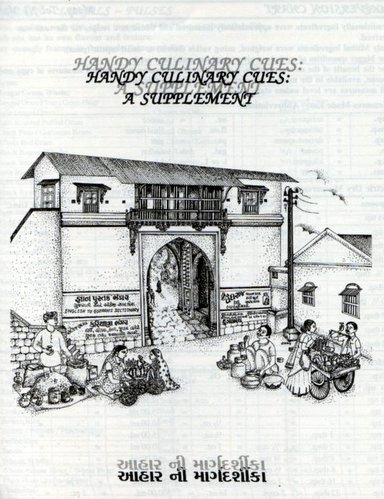
Illustration from back cover

There are color representations of every dish in the photographs in each section but in addition to this beautiful illustrations and line drawings by Ramchandrabhai Chauhan, an award winning artist augment the pages of this book, offering an insight into the traditioanal foodways and life of the Palampuri Jains.

Illustration from section header

Copies of the book are available from the Palampur Samaj Kendra,
151 Shanti, August Kranti Marg, Mumbai 36.
Phone 23632288
Posted by Picasa